
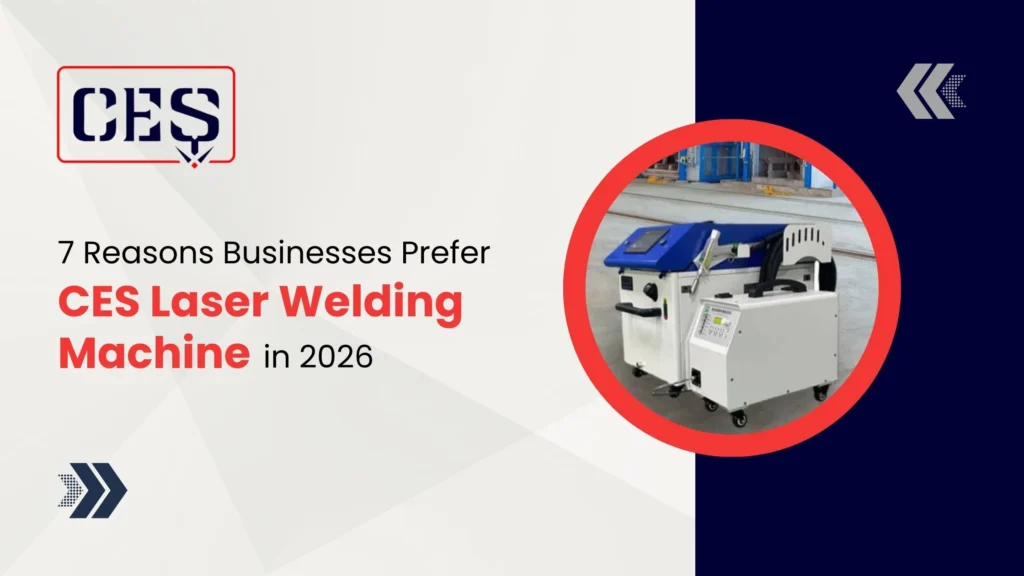
As the manufacturing sector moves towards greater precision, automation, and optimization, the use of laser welding has emerged as a popular joining method for industries like automotive, electronics, medical devices, aeronautics, and heavy engineering applications. In the year 2026, companies are likely to invest in technological advancements in laser welding.
A leading Laser Welding Machine Manufacturer is an integral part of this shift because it provides machines that give better weld quality along with lower costs of operation. CES laser welding machines have become the machine of choice for companies wanting to future-proof their production line setup. Given below are the seven most important reasons why the industries are accepting CES laser welding technology in 2026.
1. Welding Precision and Quality
The laser/arc welding machine is known for its high accuracy, and CES machines are designed to achieve clean, strong, and accurate welds. The focused beam of a laser allows it to deliver accurate energy distribution, hence creating low distortion with high-quality joints.
Precision is very useful for those industries that work with thin materials, complex geometries, and micro-components, for which conventional welding would not have been sufficiently effective because it may have entailed a certain risk level, thereby resulting in low productivity.
2. High-Speed Performance for Increased Productivity
In the competing manufacturing sectors, the speed aspect assumes significance. CES Laser Welding Machines have a higher speed without affecting the quality of welding. The quicker welding cycles enable manufacturers to achieve their target deadlines with ease.
Since the time needed for welding each part of a product with the use of a laser can be considerably shorter, the efficiency of the companies can greatly improve, making it an appropriate business decision to undertake this technology on a massive production basis.
3. Flexibility Across Materials and Applications
One of the strongest advantages of CES laser welding machines is their flexibility. They are capable of welding a wide range of materials, including:
- Stainless steel
- Carbon steel
- Aluminum and aluminum alloys
- Copper and brass
This adaptability makes them suitable for diverse applications, from precision electronics to heavy industrial fabrication. A top Laser Welding Machine Manufacturer ensures machines are designed to handle varying thicknesses and material combinations with ease.
4. Energy Efficiency and Lower Operating Costs
Laser welding has been found to be power efficient compared to conventional welding processes. CES machines use less power compared to conventional machines, giving optimal results.
This directly means that reduced energy usage equates to minimized operating expenses throughout the machine’s entire life cycle. Furthermore, the low usage of consumables such as filler wires and gases adds to such savings, making laser welding sustainable and economical.
5. Reduced Heat Affected Zone (HAZ)
Too much heat may reduce the strength of materials, causing warping. CES laser welding systems provide a focused heat input, creating a small Heat Affected Zone (HAZ).
It has a reduced thermal effect, therefore, it is very beneficial in maintaining the properties of the materials being joined as well as the finished weld quality in terms of its strength and appearance. It is very ideal in fields where accuracy matters most.
6. Easy Automation and Smart Manufacturing Integration
Today, manufacturing is greatly dependent upon automation and smart systems. CES laser welding systems are friendly when it comes to integration with robotics, CNC systems, and Industry 4.0.
The presence of features like programmable controls, real-time monitoring, and data connectivity allows for enhanced processes and quality control when carried out through automated lines.
7. Low Maintenance and Long Service Life
Downtime can be costly in manufacturing. CES laser welding machines are built with robust components and require minimal maintenance compared to traditional welding equipment.
The absence of frequent electrode replacement, reduced wear parts, and stable laser sources contribute to a longer service life. Businesses advantages from higher machine availability, lower maintenance costs, and predictable performance over time.
CES Laser Welding vs Traditional Welding
|
Feature |
CES Laser Welding |
Traditional Welding |
|
Welding Speed |
Very High |
Moderate |
|
Precision |
Excellent |
Average |
|
Heat Affected Zone |
Minimal |
Large |
|
Energy Efficiency |
High |
Lower |
|
Maintenance Needs |
Low |
High |
Why Businesses Trust CES Laser Welding Technology
In 2026, corporations are focusing on technology that provides speed, accuracy, productivity, and scalability. The CES laser welding machines satisfy this requirement because they ensure high-quality welding, efficiency, and smooth automation integration. From welding quality to how it performs in the future, it’s very obvious that there’s an abundance of benefits. As a leading Laser Welding Machine Manufacturer, CES Laser Machine Private Limited remains at the forefront to power industries with advanced laser welding technology.