
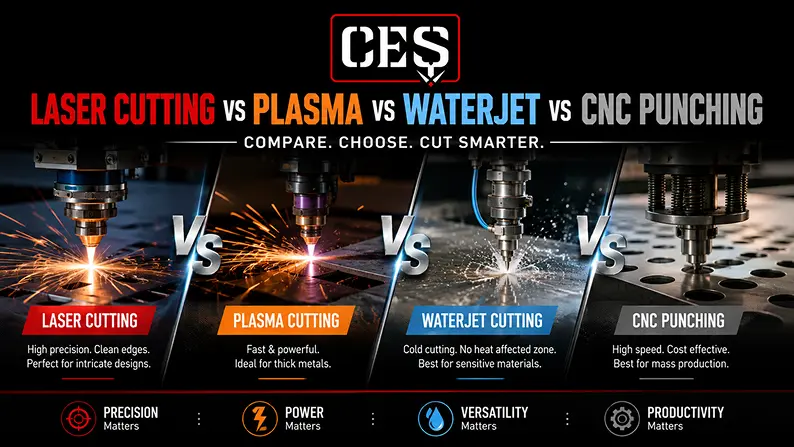
Selecting the right metal cutting technology is one of the most important decisions a fabrication shop makes. The wrong choice can mean poor edge quality, slow throughput, wasted material or a machine that never pays for itself. Laser cutting machine, plasma cutting, waterjet cutting and CNC punching each solve the problem in a different way, and each shines in a different situation.
This guide compares the four methods on the factors that actually drive the decision – precision, material type, thickness, cutting speed, production volume, heat-affected zone, edge quality and cost – so you can match the technology to your application instead of guessing.
What Is the Difference Between These Metal Cutting Methods?
All four processes cut metal, but they use completely different physics – light, ionised gas, high-pressure water or mechanical force. Understanding how each works explains why one method is perfect for a job that another struggles with.
How Does Laser Cutting Work?
Laser cutting uses a highly focused beam of light – most modern machines use a fiber laser – to melt, burn or vaporise material along a programmed path. An assist gas (nitrogen or oxygen) blows the molten metal out of the cut, leaving a clean, narrow kerf.
The beam is guided by a CNC controller, which makes it excellent for intricate profiles, small holes and repeatable precision on thin-to-medium sheet metal. You can read a deeper explanation of the technology on our laser cutting machines page.
How Does Plasma Cutting Work?
Plasma cutting forces an inert or compressed gas through a narrow nozzle and energises it into a superheated, electrically conductive plasma arc. That arc melts the metal while the gas jet blows the molten material away.
Because it relies on electrical conductivity, plasma only cuts conductive metals – but it does so quickly and cost-effectively, especially on thick plate.
How Does Waterjet Cutting Work?
Waterjet cutting uses an ultra-high-pressure stream of water, usually mixed with an abrasive garnet, to erode material along the cut line. There is no heat involved, so it is a true cold-cutting process.
This makes waterjet uniquely versatile – it can cut metals, stone, glass, ceramics and composites – and ideal for heat-sensitive alloys and very thick plates.
How Does CNC Punching Work?
A CNC punch press uses a turret of tools and dies that mechanically stamp shapes, holes, slots and louvers into sheet metal.
Because the tooling is physical, punching is extremely fast and economical for high-volume runs of the same part, but it is limited to the shapes its tools can produce.
Laser vs Plasma vs Waterjet vs CNC Punching: Quick Comparison
| Factor | Laser Cutting | Plasma Cutting | Waterjet Cutting | CNC Punching |
|---|---|---|---|---|
| Best for | Precision sheet parts | Thick metal plates | Heat-sensitive & thick materials | Repetitive high-volume parts |
| Precision | Very high | Medium | Very high | High for standard features |
| Heat-affected zone | Present (small) | Higher | None | None |
| Cutting speed | Fast on thin sheets | Fast on thick metals | Usually slower | Very fast for repeated patterns |
| Material range | Metals & selected non-metals | Conductive metals only | Almost any machinable material | Mostly sheet metals |
| Design flexibility | Excellent | Good | Excellent | Limited by tooling |
| Typical strength | Fine details & clean edges | Thickness & low cost | Cold cutting & versatility | Production volume |
Laser Cutting: Advantages and Limitations
- High precision with a very narrow kerf and tight tolerances.
- Handles intricate profiles, small holes and complex geometry with ease.
- Clean, near burr-free edges that often need no secondary finishing.
- Highly automatable and consistent for quality sheet-metal work.
- Not ideal for: very thick plate compared with plasma or waterjet, and it carries a higher machine investment.
- Recommended when: you need precision, fine detail and clean edges on thin-to-medium metal.
Plasma Cutting: Advantages and Limitations
- Cuts mild steel, stainless steel and aluminium effectively.
- Very effective on thick plate and heavy structural fabrication.
- Lower machine and operating cost than many high-precision options.
- Not ideal for: fine detail work – it produces more heat, a wider kerf and comparatively rougher edges.
- Recommended when: you cut thick conductive metal and want speed at a lower cost.
Waterjet Cutting: Advantages and Limitations
- Cold-cutting process with zero heat-affected zone or thermal distortion.
- Cuts steel, aluminium, titanium, stone, glass and composites.
- Handles very thick and heat-sensitive materials that thermal methods cannot.
- Not ideal for: high-speed production – it is slower and adds abrasive and higher operating costs.
- Recommended when: you need heat-free cutting or maximum material flexibility.
CNC Punching: Advantages and Limitations
- Ideal for repeated holes, slots, louvers and standard shapes.
- Extremely productive for large-volume sheet-metal manufacturing.
- Reduces per-part cost dramatically in repetitive production.
- Not ideal for: highly complex or frequently changing designs, because it is limited by available tooling.
- Recommended when: you produce a high volume of identical sheet-metal parts.
Comparison Based on Cutting Precision
Precision comes down to tolerance, kerf width, hole quality and edge squareness. Laser and waterjet are the precision leaders: laser delivers an extremely narrow kerf and crisp small features, while waterjet offers tight tolerances with perfectly square, distortion-free edges.
Plasma sits in the middle – fast and capable, but with a wider kerf and more taper, so it is better positioned as a speed-and-thickness option than a precision one. CNC punching is highly repeatable for standard features but is bound by tool shape.
Comparison Based on Material Thickness
- Thin sheet metal: laser or CNC punching.
- Medium-thickness metal: laser, plasma or waterjet.
- Thick steel plate: plasma or waterjet.
- Very thick and heat-sensitive material: waterjet.
Actual limits depend on machine power, material grade and the tolerance you need, so treat these as practical guidelines rather than fixed universal numbers.
Comparison Based on Material Compatibility
- Conductive metals: plasma.
- Steel and aluminium sheet: laser.
- Stone, glass, ceramics and composites: waterjet.
- Standard sheet-metal components: CNC punching.
Cutting Speed and Production Volume
The right choice also depends on whether you are making one-off prototypes or running mass production:
- One-off or custom parts: laser or waterjet.
- Repetitive high-volume parts: CNC punching.
- Large structural plates: plasma.
- Precision batch production: fiber laser.
Heat-Affected Zone and Edge Quality
Thermal processes – laser and plasma – put heat into the material, creating a heat-affected zone (HAZ). Laser keeps this zone very small thanks to its focused beam, while plasma produces a larger HAZ and more dross.
Waterjet, being a cold-cutting process, has no HAZ at all and no risk of thermal distortion. CNC punching is also heat-free, though it can leave slight burrs that may need deburring. In general, expect the cleanest edges from laser and waterjet, with plasma usually requiring more post-processing.
Machine Cost and Operating Cost
Cost is never a single number – it is the sum of several factors:
- Initial machine investment
- Electricity consumption
- Consumables
- Nozzle, electrode and lens maintenance
- Abrasive cost (waterjet)
- Tooling cost (CNC punching)
- Labour and post-processing
As a rule, plasma has the lowest entry cost, laser offers the best balance of quality and running economy for sheet metal, waterjet has higher operating costs due to abrasive, and CNC punching becomes cheaper per part only at high volumes.
Exact figures vary with machine configuration, power, table size and level of automation.
Which Cutting Method Is Best for Your Application?
- Intricate sheet-metal designs: laser cutting.
- Thick structural steel: plasma cutting.
- Titanium or heat-sensitive alloy: waterjet cutting.
- Large volume of identical panels: CNC punching.
- Mixed jobs and frequent design changes: laser cutting.
- Materials beyond metal: waterjet cutting.
Pros and Cons at a Glance
| Method | Pros | Cons |
|---|---|---|
| Laser | Precision, clean edges, automation, design flexibility | Higher investment, limited on very thick plate |
| Plasma | Fast on thick metal, low cost | Wider kerf, larger HAZ, rougher edges, conductive metals only |
| Waterjet | No heat, cuts almost any material and thickness | Slower, abrasive cost, higher operating cost |
| CNC Punching | Very fast and cheap at volume, great for standard features | Tooling-limited, poor for complex or changing designs |
How to Choose the Right Metal Cutting Machine?
Before you buy, weigh these ten decision factors against your real workload:
- Material type
- Material thickness
- Required tolerance
- Part geometry
- Production volume
- Cutting speed
- Capital budget
- Operating cost
- Heat-distortion tolerance
- Required edge finish
If most of your work is precision sheet metal, a fiber laser usually offers the best all-round return. See how it stacks up against older technology in our comparison of fiber laser vs CO2 laser cutting machines, and why it outperforms legacy processes in laser cutting versus traditional cutting methods.
Final Verdict: Which Technology Should You Choose?
There is no single winner – only the best fit for your material, tolerance, volume and budget:
- Laser: precision and intricate designs.
- Plasma: thick conductive metal and budget-focused fabrication.
- Waterjet: heat-free cutting and maximum material flexibility.
- CNC punching: repetitive, high-volume sheet-metal production.
For the majority of Indian fabricators working with steel, stainless and aluminium sheet, fiber laser cutting delivers the strongest combination of precision, speed, edge quality and long-term operating economy.
Frequently Asked Questions
1. Can one workshop use more than one of these cutting methods?
Yes. Many fabrication shops run more than one process – a common setup pairs a fiber laser for precision and detail with plasma for thick plate or CNC punching for high-volume standard parts, so each job goes to the most cost-effective machine.
2. What maintenance does each cutting method require?
Laser needs lens and nozzle care plus optics cleaning; plasma needs regular electrode and nozzle replacement; waterjet needs pump seals, orifice and abrasive-system upkeep; CNC punching needs tool sharpening and die maintenance. Planned maintenance reduces downtime on all four.
3. Can laser cutting fully replace plasma and waterjet?
For most sheet-metal work, largely yes – but not entirely. Very thick plate is often more economical on plasma, and heat-sensitive materials or non-metals still need waterjet. Many shops keep laser as the primary machine and add the others for edge cases.
4. Can these methods cut rusted, painted or coated metal?
Waterjet and plasma handle rusted or painted surfaces well. Laser can cut them too, but heavy rust, paint or coatings can affect cut quality and fume levels, so clean material gives the best results.
5. How much power supply and floor space do these machines need?
It varies by model, but plan for a suitable three-phase supply, compressed gas or abrasive feed, extraction/ventilation and enough floor space for the bed size plus material handling. Your machine supplier can specify exact requirements.
6. Which cutting method gives the fastest return on investment?
It depends on your workload – a fiber laser usually offers the fastest ROI for varied precision sheet-metal work, CNC punching pays back quickest on very high volumes of identical parts, and plasma suits budget-focused thick-plate shops.
Looking for a Precision Metal Cutting Solution?
CES manufactures high-performance fiber laser cutting machines built for Indian fabrication shops – from sheet to tube and pipe.
Explore our range of fiber laser cutting machines or contact our team for a tailored recommendation and quote.