
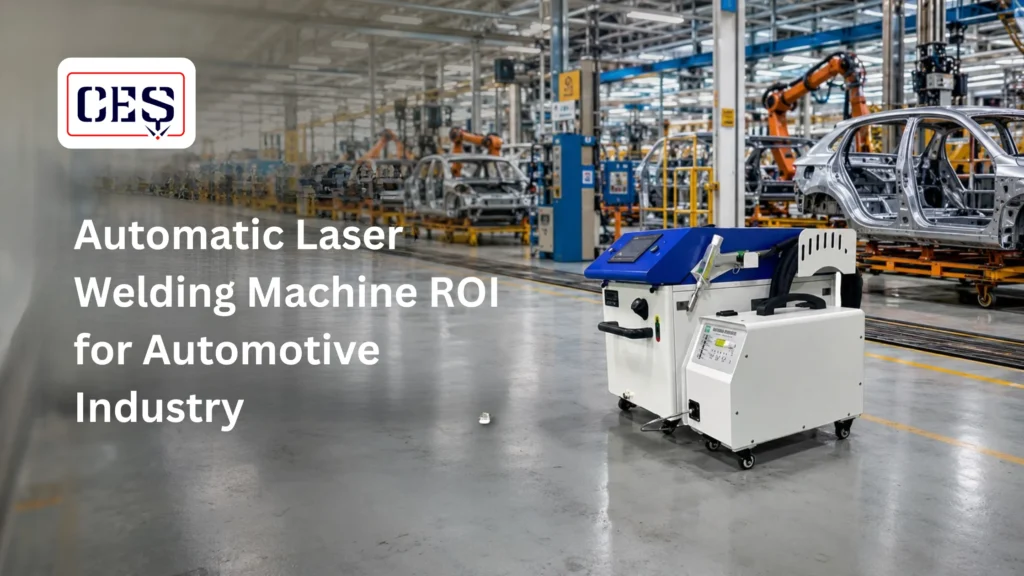
Automatic Laser Welding Machine ROI for the Automotive Industry
Automotive manufacturing runs on tight margins and tighter schedules. Whether you’re producing body panels, exhaust components, battery enclosures, or structural assemblies, your welding process sits right at the center of your production efficiency. Many manufacturers still rely on MIG or TIG welding for high-volume applications. These methods work, but they come with real limitations: slower cycle times, operator variability, higher heat input, and significant post-weld finishing costs. That’s exactly where an automatic laser welding machine starts to make a strong financial case. This blog breaks down the actual ROI of laser welding for automotive manufacturers, what drives cost savings, what the investment looks like, and how to evaluate whether the switch makes sense for your facility. Why ROI Matters Before the Purchase Decision In B2B manufacturing, every capital equipment decision comes down to numbers. It’s not just about what the machine can do, it’s about what it does for your bottom line. When evaluating a laser welding machine for automotive production, ROI should be calculated across multiple factors: Let’s look at each of these closely. How Automatic Laser Welding Reduces Cost Per Part 1. Faster Cycle Times Mean Higher Throughput Laser beam welding operates at significantly higher speeds compared to conventional arc welding processes. For thin-gauge automotive steel or aluminum, commonly used in body-in-white and EV battery tray assemblies, laser welding can complete passes in a fraction of the time. In high-volume automotive environments, even a 20-30% reduction in weld cycle time per component can translate into hundreds of additional parts per shift. More parts per shift = lower cost per unit = better margin per vehicle. 2. Minimal Heat Input Reduces Distortion and Rework One of the biggest hidden costs in traditional welding is post-weld correction. Heat distortion on thin metal panels often requires grinding, straightening, or rework, all of which add labor hours and slow down delivery. Laser welding uses a highly focused beam with low heat input. This produces a narrow weld zone, which means significantly less thermal distortion on finished parts. For automotive manufacturers, this directly reduces: These aren’t minor savings in high-volume production. They add up quickly. 3. Consistent Weld Quality Without Operator Variability Manual welding quality depends heavily on the skill and condition of the operator. Fatigue, skill gaps, or setup inconsistencies all affect weld quality, and in automotive applications, weld failures have serious consequences. An automatic laser welding machine follows programmed parameters every single cycle. The weld depth, speed, focus, and position remain consistent across the entire run. This consistency means: For suppliers working under automotive OEM quality standards, this level of process control is not optional; it’s expected. Where Laser Welding Adds the Most Value in Automotive Production Not every application is equal. The ROI of a laser welding system depends on where in your production it’s deployed. Here are the application areas where automotive manufacturers typically see the strongest returns: Application Area Why Laser Welding Works Well Body-in-White (BIW) Panels High-speed welding on thin steel/aluminum with low distortion EV Battery Enclosures Precise, hermetic seals required for safety compliance Exhaust Components Consistent weld quality on stainless steel tubing Transmission and Gear Components Tight tolerances with minimal post-processing Seating Frames and Structural Brackets High-volume repeatability on structural welds If your current production involves any of these, a detailed ROI analysis is worth running. Understanding the Investment Side of the Equation ROI is a two-sided calculation. The savings matter, but so does the total investment required. A typical automatic laser welding machine for automotive applications involves: The key question is not “How much does it cost?” It’s “How many months does it take to recover that cost?” For high-volume automotive production environments, manufacturers typically evaluate payback periods in the range of 18 to 36 months, depending on volume, part complexity, and existing rework costs. In some high-output scenarios, especially for EV battery or BIW applications, payback can be faster when rework reduction is factored in properly. Work with your equipment supplier to model this based on your actual production data, not industry averages. Key Factors That Affect Your ROI Timeline Every facility is different. These are the variables that most directly affect how quickly you recover your investment: Production Volume Higher volume shortens payback. Laser welding’s efficiency advantage compounds over thousands of parts per month. Current Rework Rate If your current process has a high rework or scrap rate, laser welding’s consistency will generate savings faster. Labor Costs In facilities with higher-skilled labor costs, reducing manual welding dependency has a direct and measurable impact on operating costs. Part Complexity Complex geometries that are hard to weld consistently with manual processes often show the fastest ROI improvement with automated laser welding. Material Type Aluminum and advanced high-strength steels, increasingly common in EV and lightweight vehicle platforms, are better suited to laser welding than conventional processes, which reduces quality-related losses. Ready to Assess Your Laser Welding ROI? If you’re evaluating an automatic laser welding machine for your automotive production line, CES Laser Machine can help you build a realistic ROI model based on your actual application. Click here What to Evaluate When Choosing an Automatic Laser Welding Machine Before committing to a purchase, evaluate these aspects carefully: Don’t evaluate machines in isolation. Evaluate the full production workflow impact. Common Mistakes Manufacturers Make With Laser Welding ROI Calculations A few miscalculations can lead to either overestimating or underestimating the ROI: Underestimating rework savings Many manufacturers only count the machine cost against cycle time savings. Rework, scrap, and finishing labor are often the bigger line items, and they’re frequently undertracked. Ignoring integration costs The machine price is not the full investment. Fixtures, programming, robot integration, and facility adjustments need to be included in your total cost of ownership. Not accounting for quality-driven revenue OEM qualification requirements increasingly favor suppliers with documented process control. Laser welding supports this, and that can open doors to higher-value contracts. Comparing only against manual welding If you’re replacing a semi-automatic process, the gap may be smaller than expected. Compare against your actual
Automatic Laser Welding Machine ROI for the Automotive Industry Read More »