
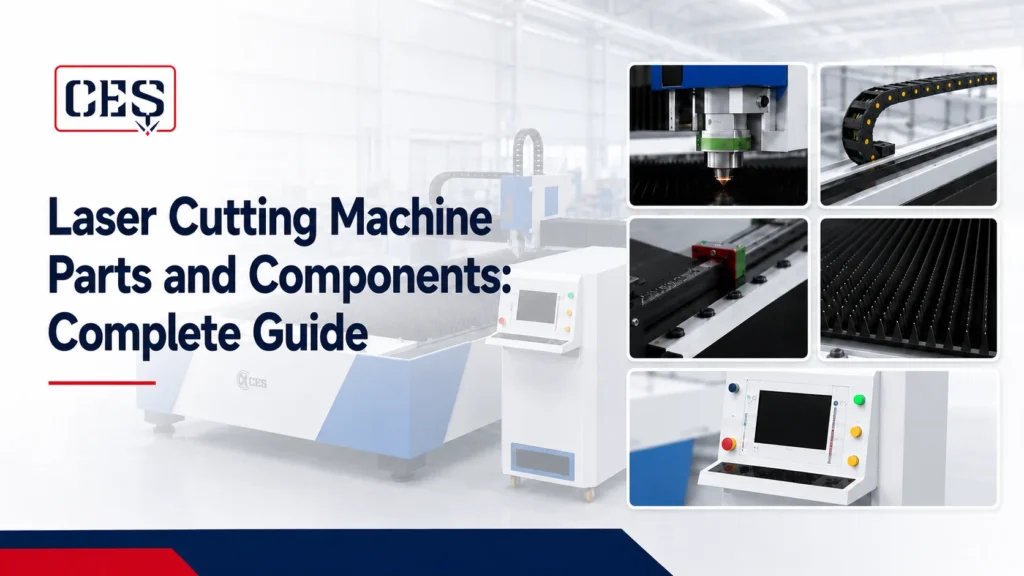
If your laser cutting machine is giving you inconsistent cuts, unexpected downtime, or rising maintenance bills, the problem usually comes down to one specific part, not the whole system.
Every laser cutting machine, whether it’s a CO2, fiber, or CNC laser cutting machine, is really a stack of components working together: optics, mechanics, electronics, and gas handling, all coordinated to turn a beam of light into a clean cut. Knowing the laser cutting machine parts name, what each one actually does, and which ones fail first makes troubleshooting faster and keeps you from ordering the wrong spare at 6 PM on a Friday.
This guide walks through the major components of laser cutting machine systems, from the laser source down to the laser cutter filter nobody thinks about until it clogs.
Why It’s Worth Knowing These Parts
A laser cutting machine isn’t one unit. It’s several systems bolted together, each with a job:
- Generating the laser beam
- Focusing that beam precisely onto the material
- Moving the head across the X, Y, and sometimes Z axis
- Supplying assist gas and clearing debris, fumes, and slag
- Running the whole process through CNC software
Once you know the components of laser cutting equipment individually, ordering the right cnc laser parts or catching a problem early stops being guesswork.
Quick Overview
| Component | Primary Function | Maintenance Frequency |
| Laser Source/Generator | Produces the laser beam | Low |
| Laser Cutting Head | Focuses and directs the beam onto material | High |
| CNC Control System | Controls motion, power, and cutting parameters | Low |
| Motion/Drive System | Moves the cutting head across X, Y, Z axes | Medium |
| Machine Bed/Frame | Provides structural support and stability | Low |
| Chiller/Cooling System | Regulates temperature of laser and optics | Medium |
| Assist Gas System | Supplies nitrogen, oxygen, or air for cutting | Medium |
| Fume Extraction & Filter | Removes smoke, dust, and particulates | High |
Laser Source: Where It All Starts
Call it the laser source, generator, or resonator, this is the single most important component of laser cutting equipment, and usually the priciest one too.
Fiber laser machines use a solid-state fiber generator. Older CO2 systems rely on a gas resonator instead. Either way, this part sets your ceiling: how thick a material you can cut, and how fast.
Fiber has mostly taken over for metal cutting because it runs cheaper and more efficiently than CO2. If you’ve shopped around for fiber laser parts, you’ve probably already run into the usual names, IPG, Raycus, MAX, JPT, each offering slightly different price-to-power ratios.
Because there aren’t many moving parts inside a laser source, it needs the least day-to-day attention of anything on this list. That’s the good news. The bad news is that when it does fail, it’s the most expensive thing on the machine to replace.
The Cutting Head: Precision Lives Here
If the laser source is the engine, the fiber laser cutting head is the nozzle end where the actual work happens. Cut quality traces back to this part more than almost anything else.
Inside, you’ll typically find:
• nozzle, which directs both the beam and the assist gas onto the material
• focus lens that concentrates the beam into a fine, high-energy point
• focus tracking system, keeping the nozzle at a consistent height above the material
• protective window shielding the lens from spatter
A dirty or damaged nozzle shows up immediately as rough edges. A contaminated lens quietly loses power over time, and if nobody notices, it can burn out entirely. Bad tracking gives you inconsistent depth, especially on warped or uneven sheet.
Raytools, Precitec, WSX, and BOCI are the brands you’ll see most often on laser cutter head listings, with heavier machines usually pairing up with heads built to handle sustained thermal load.
CNC Control System
This is what turns a design file into actual machine movement, arguably the most underrated of all the cnc laser parts because everyone notices the laser source but few people talk about the software running it.
It interprets DXF or DWG files into cutting instructions, adjusts speed, power, and focus height on the fly, and keeps the motion system in sync so cuts come out repeatable rather than approximate.
Cypcut, Lantek, and Raytools X3S show up frequently in this space. A well-calibrated system cuts down on scrap significantly, and it’s worth remembering that software updates can improve cutting speed on a machine you already own, without touching a single physical part.
Motion and Drive System
Somebody has to actually move that cutting head, and that’s the job of servo or stepper motors paired with linear guides and rails.
Servo motors cost more but handle high-precision, high-load work well. Stepper motors are the budget option, fine for lighter applications where extreme accuracy isn’t the priority.
Worn rails or bearings are, honestly, one of the most common causes of vibration marks and edge inconsistency, and they get blamed on the laser or the head far more often than they should.
Machine Bed and Frame
Everything else depends on this being solid. You can have the best laser source and cutting head money can buy, but if the frame flexes during a cut, quality suffers anyway.
Gantry, cantilever, and beam-type are the common frame designs. Beds are usually stress-relieved steel, built specifically to resist warping over years of use. A rigid frame matters more at higher cutting speeds, where even small vibrations get amplified into visible defects.
Chiller: The Part Everyone Forgets Until It’s Too Late
The chiller circulates coolant around the laser source and cutting head optics. Skip proper cooling and both degrade fast.
Done right, it extends the laser source’s life, keeps beam quality consistent across long runs, and protects expensive optics from heat damage. Neglect it, and you’re looking at premature laser failure or a slow drift in beam quality that’s hard to diagnose until output drops noticeably.
Topping up or replacing coolant is routine maintenance that a lot of shops genuinely put off until something forces the issue.
Assist Gas System
Nitrogen, oxygen, or plain compressed air, whichever your process uses, gets delivered through cylinders, regulators, filters, and piping straight to the cutting head.
Gas purity and pressure affect edge quality directly. Poor filtration in the line is a sneaky problem: moisture or oil gets into the cutting head and damages the lens before anyone realizes what’s happening. High-volume shops increasingly install on-site nitrogen generators just to cut down on gas costs over time.
Fume Extraction and the Laser Cutter Filter
Cutting metal produces smoke, fumes, and fine particulate, and the extraction system pulls all of that away before it settles on the optics.
This protects the lens and mirrors, keeps the air breathable for operators, and stops residue from affecting cut quality on reflective or coated materials. The laser cutter filter itself is a consumable, not something you install once and forget. A clogged filter cuts suction efficiency, which means more debris reaching the optical path, and that’s a surprisingly common root cause behind cutting head damage that gets blamed on something else entirely.
How to Choose the Right Parts
A rough framework, depending on what you’re actually running:
- Cutting thick metal at volume? Go higher-wattage on the source, heavy-duty on the head.
- Fine detail work that needs to stay accurate long-term? Put your budget into the CNC system and servo-driven motion.
- Running 8+ hours a day? Don’t cheap out on the chiller or gas filtration; these are usually the first to fail under sustained load.
- Dusty or high-volume environment? Size up your fume extraction and filter capacity accordingly.
- Ordering spares? Match OEM specs exactly. A mismatched nozzle or lens is a more common cause of poor cuts than people expect.
What to Expect on Maintenance and Replacement
Not everything wears at the same pace:
• High-wear: nozzles, protective windows, filters, expect to replace these regularly
• Medium-wear: focus lens, gas regulators, coolant, periodic servicing
• Low-wear: laser source, frame, CNC hardware, long life if maintained, but expensive if something goes wrong
A quick inspection of the head and filtration system now and then catches most problems early. It’s a lot cheaper than finding out the hard way with a burned-out lens or a dead laser source.
Final Thoughts
Knowing the parts of laser cutting machines isn’t just trivia for troubleshooting; it shapes what you buy, how you maintain the machine, and what your actual running costs look like.
The laser source and cutting head deserve most of the attention when you’re buying or upgrading. The CNC system and motion components are what give you precision and repeatability. And cooling, gas supply, filtration, the stuff people forget about, is usually where preventable downtime actually starts.
Learn your laser cutting machine parts name by name, and troubleshooting stops being a guessing game.
Frequently Asked Questions (FAQs)
1. What’s the difference between a fiber laser and a CO2 laser cutting machine?
A fiber laser uses a solid-state generator and is more efficient, faster, and cheaper to run for metal cutting. A CO2 laser runs on a gas resonator and performs better on non-metals like acrylic, wood, and plastic. This is why most metal fabrication shops have shifted toward fiber machines.
2. Which assist gas is better for laser cutting, nitrogen or oxygen?
It depends on the material and the finish you need. Nitrogen delivers clean, oxidation-free edges, making it ideal for stainless steel and aluminium, but it’s expensive. Oxygen cuts thick carbon steel faster because the exothermic reaction boosts cutting speed, though it leaves a thin oxide layer on the edge.
3. How can I increase the cutting speed of my laser cutting machine?
Speed depends on the laser source wattage, material thickness, assist gas pressure, and focus setting. Choosing the right nozzle diameter, keeping the optics clean, and updating the CNC software often deliver noticeable improvements without changing any hardware.
4. What is the average lifespan of a laser cutting machine?
With good maintenance, the frame and CNC hardware can last 10+ years, and a quality fiber source often reaches around 100,000 operating hours. Consumables need regular replacement, but the core system delivers long service with proper cooling and care.