

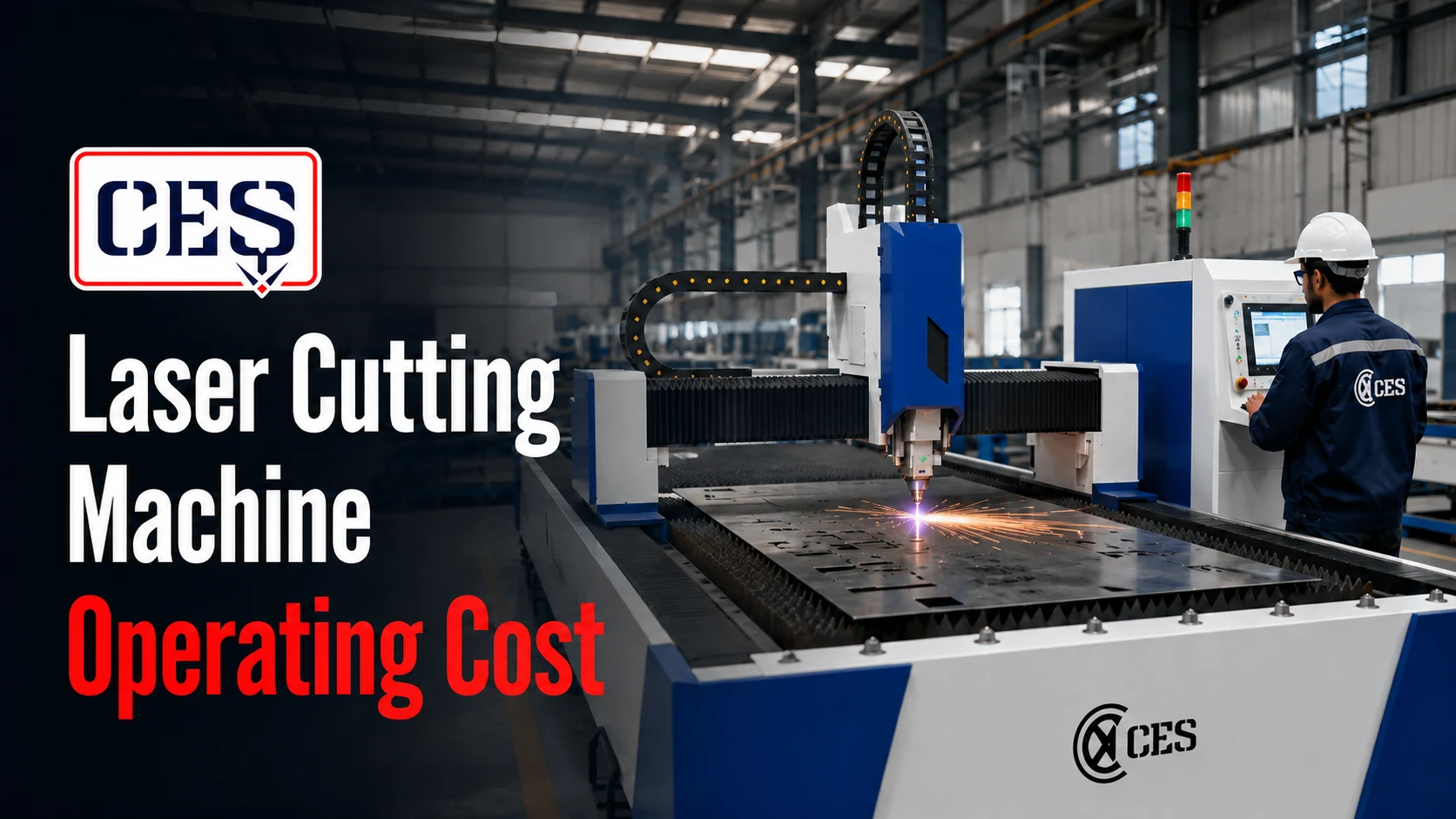
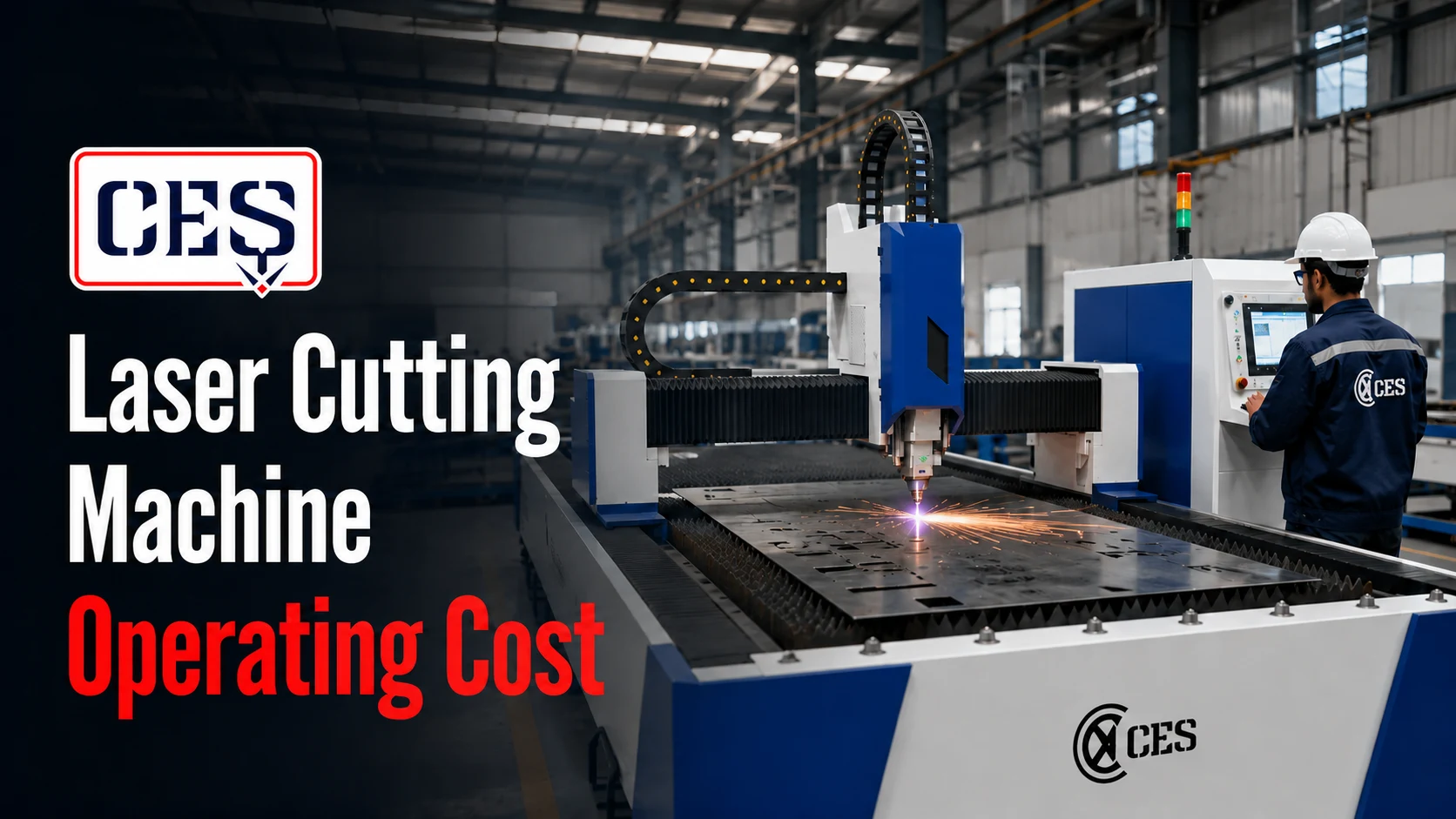
Running a fiber laser cutting machine costs roughly ₹750-₹1,400 per hour in direct operating expenses - electricity, assist gas, consumables and maintenance. After adding machine depreciation and labour, the full rate charged to customers is typically ₹3,000-₹8,000 per hour. Assist gas (nitrogen) and electricity are the two biggest cost drivers.
The laser cutting machine operating cost is the total money you spend to keep the machine cutting for one hour. It is different from the machine's purchase price. Knowing your true running cost per hour is essential to price jobs correctly, protect your margins and compare one cutting technology against another.
Operating cost is usually split into two views: the direct operating cost (electricity, assist gas, consumables and maintenance) and the full shop rate (which also adds machine depreciation, labour and overhead) that you charge customers. This guide breaks down both, with India-context figures for a fiber laser.
The 6 Key Cost Drivers in Laser Cutting Operations
Every rupee of running cost falls into six buckets. Their approximate share of total cost is:
| Cost Driver | Typical Share of Cost |
|---|---|
| Assist gas (nitrogen / oxygen / air) | 30–50% |
| Electricity | 20–30% |
| Depreciation (machine ownership) | 15–25% |
| Labour & overhead | 10–20% |
| Consumables (nozzles, lenses, ceramics) | 5–10% |
| Routine maintenance | ~5% |
1. Electricity Cost: How Much Power Does a Fiber Laser Really Use?
Electricity is the most predictable cost. The simple formula is: Electricity cost per hour = average wall-plug power (kW) × electricity rate (₹/kWh). Fiber lasers are far more energy-efficient than older CO₂ systems, drawing only a fraction of their rated power at the wall.
| Laser Power | Consumption | Electricity Cost (@ ₹10/kWh) |
|---|---|---|
| 3 kW fiber | 14–17 kWh/hr | ₹140–₹170/hr |
| 6 kW fiber | 25–30 kWh/hr | ₹250–₹300/hr |
| 12 kW fiber | 48–58 kWh/hr | ₹480–₹580/hr |
| 2 kW CO₂ (older) | 30–40 kWh/hr | ₹300–₹400/hr |
Indian industrial tariffs typically range ₹8-₹12/kWh, so adjust the figures to your state's rate. Note how a 2 kW CO₂ machine can consume more power than a 6 kW fiber laser - a major reason shops switch to fiber.
2. Assist Gas Cost: Oxygen vs Nitrogen vs Air
Assist gas blows molten metal out of the cut and is often the single largest operating expense - especially nitrogen cutting of stainless steel.
- Nitrogen (N₂) - Gives clean, oxide-free edges but is consumed at high volume and pressure - the most expensive gas, and the biggest lever on your total cost.
- Oxygen (O₂) - Uses lower flow and speeds up cutting of mild steel, but leaves an oxidised edge; moderate cost.
- Compressed air - The cheapest option (mainly compressor electricity), but limited to thinner material and lower edge quality.
For an Indian shop, nitrogen supplied through cylinders is costly; an on-site nitrogen generator has a higher upfront cost but sharply reduces the per-hour gas bill on high-volume nitrogen cutting.
3. Consumables: Nozzles, Lenses & Ceramics
Cutting nozzles, protective lenses and ceramic rings wear out and need regular replacement. Averaged over a shift, consumables typically add ₹100–₹250 per hour, depending on your material mix, thickness and duty cycle. Keeping optics clean and the nozzle correctly aligned extends consumable life.
4. Routine Maintenance Reserve
Planned maintenance - chiller service, optics cleaning, alignment and rail lubrication - usually runs ₹2-₹3 lakh per year for a high-power machine. Spread over about 2,000 productive hours a year, that is roughly ₹100-₹150 per hour set aside as a maintenance reserve, which prevents surprise breakdowns and downtime.
5. Depreciation & Machine Hourly Rate
To recover the capital you invested, add a machine-hour rate. The formula is: Machine-hour rate = annual machine cost (purchase + interest + insurance) ÷ annual productive hours.
Example: a ₹1.5 crore machine over 5 years at 2,000 hours/year = ₹1.5 cr ÷ (5 × 2,000) = ₹1,500 per hour of ownership cost alone. This is a TCO (total cost of ownership) figure, separate from the direct operating cost.
6. Labour & Overhead
Operator wages, shop rent, software licences, electricity for the rest of the shop and administrative costs often double the bare operating cost when you price a job. This is why the full rate charged to customers is much higher than the machine's direct running cost.
Real-World Example: 6 kW Fiber Laser Cost Breakdown (India)
| Cost Component | ₹ per hour | Notes |
|---|---|---|
| Electricity | ₹250-₹300 | 25–30 kWh @ ₹10/kWh |
| Nitrogen assist gas | ₹300-₹800 | varies with pressure, thickness & gas source |
| Consumables | ₹100-₹150 | nozzles, lenses, ceramics averaged |
| Maintenance reserve | ₹100-₹150 | ~₹2–3 lakh/yr ÷ 2,000 hrs |
| Direct operating cost | ₹750-₹1,400 | ≈ US$9–17/hr |
| Depreciation (TCO) | ₹1,000-₹1,500 | ₹1–1.5 cr over 5 yrs |
| Labour & overhead | ₹500-₹1,500 | operator + shop |
| Full job rate (customer) | ₹3,000-₹8,000 | typical market pricing |
Figures are indicative - your exact cost depends on laser power, gas source, electricity tariff, utilisation and material mix.
Laser vs Plasma vs Waterjet: Operating Cost Comparison
| Method | Main Operating Cost | Cost Character |
|---|---|---|
| Fiber laser | Assist gas + electricity | Efficient power use; nitrogen is the big variable |
| Plasma | Consumables (electrodes, nozzles) | Low entry cost, frequent consumable changes |
| Waterjet | Abrasive (garnet) + water | Highest running cost; slow but no heat |
For a fuller technical comparison, read our guide comparing fiber laser vs CO2 laser cutting machines and how fiber laser cutting boosts ROI and efficiency .
How to Reduce Your Laser Cutting Operating Cost by 20-30%
- Switch to a nitrogen generator - Cut cylinder gas bills on high-volume nitrogen work.
- Use the right gas for the job - Air or oxygen instead of nitrogen where edge quality allows.
- Optimise nesting - Fit more parts per sheet to cut material and cycle waste.
- Run in off-peak hours - Use lower night-time electricity tariffs where available.
- Maintain optics and nozzles - Clean optics and aligned nozzles reduce consumable and rework cost.
- Match power to your work - Right-size the laser wattage to your thickness to avoid over-spending on energy.
- Reduce idle time - Idle machine hours still cost electricity, labour and depreciation with no output.
Frequently Asked Questions
1. Is a fiber laser cheaper to run than a CO₂ laser?
Yes. A fiber laser draws much less wall-plug power for the same cut, and needs fewer consumables and less maintenance than a CO₂ system - so its per-hour running cost is significantly lower.
2. Does cutting thicker metal increase the cost per hour?
Generally yes. Thicker sheet cuts slower and often uses more assist gas and power per metre, so the effective cost per hour - and per part - rises with thickness.
3. How many productive hours per year should I use in the calculation?
Most shops assume around 2,000 productive hours per year for a single-shift operation. If you run two shifts, your machine-hour and depreciation cost per hour fall because the fixed cost is spread over more hours.
4. How do I turn operating cost into a price for customers?
Add your direct operating cost, machine-hour (depreciation) rate, labour and overhead, then apply your profit margin. Many shops quote per hour, per part or per metre of cut once this base rate is known.
5. Do electricity and gas costs vary across Indian states?
Yes. Industrial electricity tariffs and local gas pricing differ by state and supplier, so always plug your own ₹/kWh rate and gas cost into the formulas rather than relying on a national average.