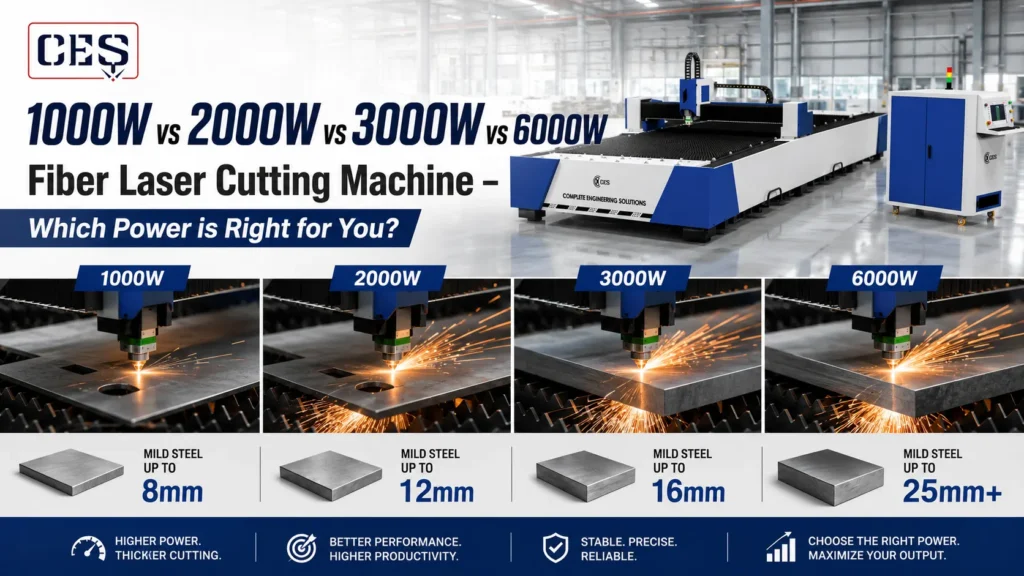
1000W suits thin metals (up to 6 mm) for small workshops and decorative work. 2000W handles medium fabrication up to 12 mm – the most versatile choice for most businesses. 3000W is ideal for heavy fabrication requiring speeds on thick steel up to 20 mm. 6000W is for high-volume industrial operations cutting plates up to 30 mm+. Match power to your thickest material and your required production speed – not the highest number available.
When you are buying a fiber laser cutting machine, power selection is the most consequential decision you will make. Choose too low and your machine cannot cut the materials your business needs. Choose too high and you overpay on capital cost, electricity, and maintenance for capability you will never use. This guide breaks down the real differences between 1000W, 2000W, 3000W, and 6000W fiber laser cutting machines – with exact material thicknesses, cutting speeds, operating costs, and industry recommendations – so you can invest in exactly the right machine.
Why Does Laser Power Level Matter?
Laser power – measured in watts (W) – directly determines two things: the maximum material thickness the machine can cut cleanly, and the speed at which it cuts a given thickness. Higher power delivers more energy to the cut zone, which means it can penetrate thicker material and complete cuts faster.
But power is not the only variable. Cutting speed, assist gas type (nitrogen, oxygen, or compressed air), material reflectivity, and beam quality all interact with power output. A well-configured 2000W machine from a quality manufacturer can outperform a poorly configured 3000W machine on certain applications. This is why understanding the full picture matters before you buy.
Rule of thumb: Select power based on your thickest material in regular production – not your occasional heaviest job. For edge cases, factor in a 20–30% power buffer.
What Each Power Level Can Do: A Practical Overview
1000W Fiber Laser Cutting Machine
A 1000W machine is the entry point for industrial fiber laser cutting. It cuts thin sheet metals cleanly and cost-efficiently. It is best suited for businesses that primarily work with materials under 6 mm – signage fabricators, decorative metalwork producers, and small precision workshops. At 1000W, operating costs (electricity, consumables) are the lowest of all power tiers, making it financially accessible for startups and small manufacturers.
It struggles with copper and brass at any meaningful thickness due to their high reflectivity, and it is not recommended for mild steel above 10 mm because cutting speeds become economically unviable.
2000W Fiber Laser Cutting Machine
The 2000W machine is the most popular power level globally – and for good reason. It offers the best balance of cutting capability, speed, energy consumption, and purchase price. It handles the full range of materials needed by most mid-sized manufacturers: stainless steel up to 8 mm, mild steel up to 16 mm, and aluminium up to 6 mm – all at commercially viable cutting speeds.
For businesses in automotive components, kitchen equipment, fitness equipment, or general sheet metal fabrication, a 2000W machine covers 80–90% of production requirements at a lower investment than 3000W+ models.
3000W Fiber Laser Cutting Machine
At 3000W, the machine moves into heavy fabrication territory. Cutting speeds on medium-thickness steel increase significantly compared to 2000W – often 30-50% faster on 6-10 mm mild steel 0 which directly translates to higher throughput and lower cost per part in volume production. Maximum cutting thickness extends to 20 mm mild steel and 12 mm stainless steel.
3000W is the preferred choice for structural steel fabricators, elevator component manufacturers, and large OEMs who run multi-shift operations and need consistent high-speed performance across varied material thicknesses.
6000W Fiber Laser Cutting Machine
A 6000W machine is an industrial-grade workhorse designed for maximum throughput on thick materials. It can cut mild steel plates up to 30 mm or more, stainless steel up to 20 mm, and aluminium up to 18 mm – at speeds that make high-volume production economically viable. It is the standard choice for heavy engineering, pressure vessel fabrication, shipbuilding, and defence manufacturing.
The tradeoff is significant: higher machine cost, higher electricity consumption (40-50 kW), and higher maintenance costs. For businesses that do not regularly cut material above 16 mm, the economics rarely justify 6000W over 3000W.
1000W vs 2000W vs 3000W vs 6000W: Full Comparison Table
All thickness figures are approximate maximum values for clean cuts using appropriate assist gas. Actual performance depends on machine configuration, beam quality, and material grade.
| Parameter | 1000W | 2000W | 3000W | 6000W |
| Mild/Carbon Steel – Max Thickness | Up to 10 mm | Up to 16 mm | Up to 20 mm | Up to 30 mm+ |
| Stainless Steel – Max Thickness | Up to 5 mm | Up to 8 mm | Up to 12 mm | Up to 20 mm |
| Aluminum – Max Thickness | Up to 3 mm | Up to 6 mm | Up to 10 mm | Up to 18 mm |
| Copper / Brass – Max Thickness | Up to 2 mm | Up to 3 mm | Up to 5 mm | Up to 8 mm |
| Cutting Speed (3 mm SS) | Moderate | Fast | Very Fast | Extremely Fast |
| Cutting Speed (10 mm MS) | Not Recommended | Moderate | Fast | Very Fast |
| Assist Gas | N₂ / O₂ / Air | N₂ / O₂ / Air | N₂ / O₂ / Air | N₂ / O₂ / Air |
| Electricity Consumption | Low (~8–10 kW) | Medium (~15–18 kW) | Medium-High (~20–25 kW) | High (~40–50 kW) |
| Machine Cost (Relative) | Lowest | Moderate | High | Highest |
| Operating Cost per Hour | Lowest | Low–Medium | Medium | High |
| Ideal Material Thickness Range | 0.5 mm – 6 mm | 0.5 mm – 12 mm | 1 mm – 16 mm | 2 mm – 25 mm+ |
| Best For | Signs, décor, thin sheet | Auto parts, kitchenware | Heavy fab, structural | Industrial, high-volume |
| Business Type | Small workshops, startups | Medium manufacturers | Large fabricators | Heavy industry, OEMs |
Which Power Level is Right for Your Industry?
Use this table to match your specific industry or application to the recommended power range.
| Industry / Application | Recommended Power | Reason |
| Signage & Advertising | 1000W – 2000W | Mainly thin sheets, aluminium composites, acrylic-bonded metals |
| Kitchen Equipment / Cookware | 2000W – 3000W | Medium SS thickness, high production volume required |
| Automotive Components | 2000W – 3000W | Varied thicknesses, speed-critical operations |
| Fitness Equipment | 2000W – 3000W | Tubes + sheet metal, complex profiles |
| Structural Steel Fabrication | 3000W – 6000W | Thick mild steel sections, heavy profiles |
| Elevator & Escalator Parts | 3000W – 6000W | Large steel panels and structural components |
| Pressure Vessels / Boilers | 6000W | Thick plates, high-precision cuts on heavy metals |
| Shipbuilding / Defence | 6000W+ | Maximum thickness, high throughput demanded |
Does Higher Wattage Always Mean a Better Machine?
No, and this is the most important point in this guide. Higher wattage means more capability on thick materials and higher speeds, but it also means:
• Higher purchase price: sometimes 2x to 3x the cost of a lower-power model
• Higher electricity bills: a 6000W machine draws 4-5x the power of a 1000W model in operation
• Higher consumable and maintenance costs: nozzles, lenses, and gas consumption increase with power
• No benefit on thin materials: a 6000W machine cutting 1 mm stainless steel is wasteful – a 2000W does it equally well
The right machine is the one that matches your actual production requirements – not the most powerful machine on the market. Oversizing your machine adds cost without adding value for your specific application.
Tip: Always share your material list (type + thickness + monthly volume) with your machine supplier before finalising the power level. A reputable manufacturer will recommend the optimal – not the most expensive – option.
Power vs. Cost: What Should You Budget?
Machine prices vary by manufacturer, configuration, bed size, and included features. However, the general pricing relationship in the global market is consistent:
• 1000W: Entry-level investment – suitable for startups and light-production shops
• 2000W: Moderate investment – best ROI for most small and mid-sized manufacturers
• 3000W: Significant investment – justified when production volume and material thickness demand it
• 6000W: Premium investment – ROI depends on continuous high-volume, thick-material production
Beyond the purchase price, always calculate your total cost of ownership (TCO) over 5 years – including electricity, consumables, maintenance, and operator time. A lower-power machine with lower operating costs often delivers better TCO for businesses with moderate production requirements.
Choosing the Right Machine from a Trusted Manufacturer
Once you know which power level suits your business, the next step is selecting the right manufacturer. CES Laser Machine Private Limited manufactures fiber laser cutting machines across all major power levels – from 1000W to 6000W and above – with global after-sales support in 12 languages. Each machine is built to deliver consistent cutting quality across mild steel, stainless steel, aluminium, copper, and brass.
Frequently Asked Questions (FAQ)
1. What is the difference between 1000W and 2000W fiber laser cutting machine?
A 2000W fiber laser cutting machine can cut approximately 60–80% thicker materials than a 1000W model. For example, on stainless steel, a 1000W cuts up to 5 mm cleanly while a 2000W reaches 8 mm. Cutting speed on the same material is also significantly faster with 2000W. The 2000W model consumes more electricity but offers far greater production versatility, making it the better investment for most growing businesses.
2. Is a 3000W fiber laser worth the extra cost over 2000W?
A 3000W machine is worth the extra cost if you regularly cut material thicker than 10 mm or if cutting speed is critical to your production schedule. For businesses primarily working with material under 10 mm, a well-configured 2000W machine delivers comparable results at lower capital and operating cost. Evaluate your actual material mix before upgrading to 3000W.
3. What materials can a 1000W fiber laser cut?
A 1000W fiber laser can cut mild/carbon steel up to 10 mm, stainless steel up to 5 mm, aluminium up to 3 mm, and copper up to 2 mm. It is most effective on materials in the 0.5 mm to 4 mm range, where it delivers clean cuts at commercially viable speeds. Thick or highly reflective materials (copper, brass) are not recommended at 1000W.
4. Which fiber laser power is best for stainless steel cutting?
For thin stainless steel (up to 5 mm), a 1000W to 2000W machine is sufficient. For medium thickness (6-12 mm), a 2000W to 3000W machine is recommended. For stainless steel above 12 mm – used in pressure vessels, food processing equipment, or industrial tanks – a 6000W machine is required. Always use nitrogen as the assist gas for stainless steel to prevent oxidation on the cut edge.
5. How much electricity does a fiber laser cutting machine use?
Power consumption depends on the laser source rating. Approximately: 1000W machines draw 8-10 kW, 2000W machines draw 15-18 kW, 3000W machines draw 20-25 kW, and 6000W machines draw 40-50 kW during active cutting. Idle and standby consumption is lower. When calculating operating costs, factor in 8-16 hours of daily operation and your local electricity rate.
6. Can a 2000W fiber laser cut 10 mm mild steel?
Yes, a 2000W fiber laser can cut 10 mm mild steel, but at a slower speed compared to a 3000W machine. Using oxygen as the assist gas improves cutting speed on mild steel at this thickness. If 10 mm mild steel is a regular production material (not occasional), a 3000W machine will deliver significantly better throughput and lower cost per part over time.
7. What is the maximum thickness a 6000W fiber laser can cut?
A 6000W fiber laser can cut mild/carbon steel up to 30 mm or more, stainless steel up to 20 mm, and aluminium up to 18 mm. Actual maximum thickness depends on the specific machine configuration, beam quality, assist gas pressure, and the acceptable cut quality (edge smoothness and dross level). For cutting at maximum thickness, oxygen is typically used for carbon steel and nitrogen for stainless steel.