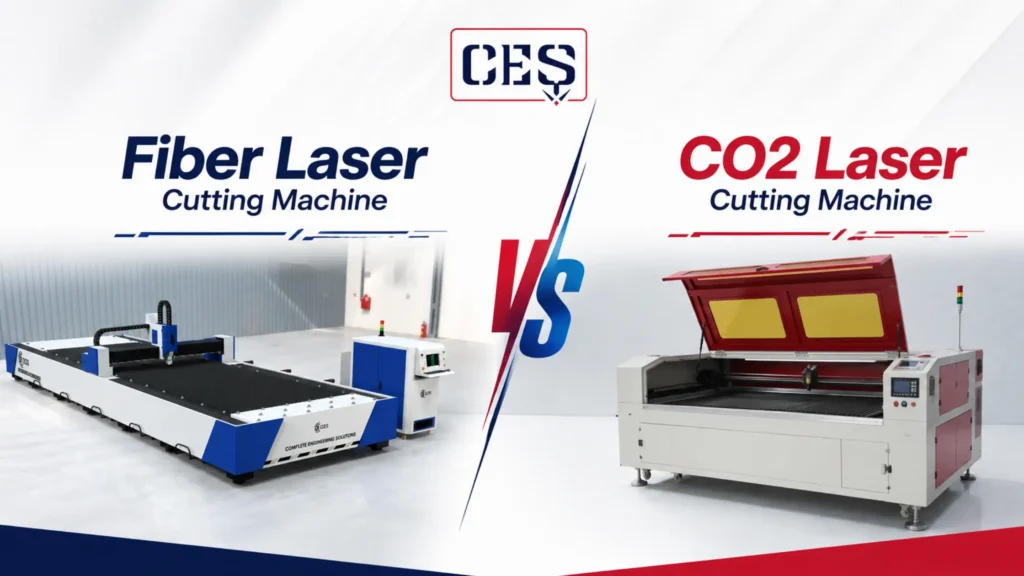
If you are planning to invest in a laser cutting machine in 2026, one question will stop you before anything else: fiber laser or CO2 laser – which is better?
Both technologies have been around for decades. But the gap between them has grown significantly in the last few years, and in 2026, the answer is no longer as complicated as it used to be.
This guide breaks down everything: speed, running cost, material compatibility, ROI, payback period, and which machine makes more sense for your specific business. Whether you run a small fabrication shop or a mid-scale manufacturing unit, this comparison will help you make the right call.
What Is a Fiber Laser Cutting Machine?
A fiber laser cutting machine uses a solid-state laser source where the beam is generated through optical fibres doped with rare-earth elements like ytterbium. The beam is delivered directly to the cutting head without the need for mirrors or gas-filled tubes.
Fiber lasers operate at a wavelength of 1.06 microns, which is highly absorbed by metals. This makes fiber laser the dominant technology for cutting mild steel, stainless steel, aluminium, brass, copper, and other reflective metals.
What Is a CO2 Laser Cutting Machine?
A CO2 laser uses a gas mixture – typically carbon dioxide, nitrogen, and helium – excited by electrical discharge to produce the laser beam. CO2 lasers operate at a wavelength of 10.6 microns.
This longer wavelength is well absorbed by organic and non-metallic materials. CO2 lasers have traditionally been used for cutting acrylic, wood, MDF, leather, fabric, rubber, and thin non-metals. They can cut metals too, but are significantly less efficient compared to fiber lasers on thicker or reflective materials.
Fiber Laser vs CO2 Laser: Head-to-Head Comparison
| Parameter | Fiber Laser | CO2 Laser |
|---|---|---|
| Cutting Speed (thin metal) | 3–5x faster | Slower |
| Best Material | All metals | Non-metals + thin metals |
| Wavelength | 1.06 microns | 10.6 microns |
| Running Cost | Low | High |
| Maintenance | Minimal | High (mirrors, gas tubes) |
| Power Consumption | 30–40% less | Higher |
| Cutting Thickness (metal) | Up to 50mm+ | Limited on thick metal |
| Reflective Metal Cutting | Excellent | Risk of back-reflection |
| Machine Lifespan | 100,000+ hours | 20,000–30,000 hours (tube) |
| Price in India (entry level) | Rs.25–35 lakh | Rs.8–18 lakh |
Fiber Laser vs CO2: Cutting Thickness Comparison
One of the most common questions buyers ask: which machine cuts thicker material better? Here is a direct comparison on the three most common thicknesses – 3mm, 6mm, and 12mm:
3mm Mild Steel
Fiber laser cuts at approximately 10–14 metres per minute. CO2 laser cuts at 3-5 metres per minute.
Winner: Fiber laser – 3x faster, cleaner edge
6mm Mild Steel
Fiber laser handles 6mm effortlessly with nitrogen or oxygen assist. CO2 laser struggles beyond 6mm, edge quality drops.
Winner: Fiber laser – better edge finish, faster cycle time
12mm Mild Steel
Fiber laser (2kW–3kW) cuts 12mm cleanly with oxygen assist. CO2 laser (3kW+) can cut 12mm but speed is significantly lower and edge quality is poor.
Winner: Fiber laser – no contest at this thickness
For non-metals like 3mm acrylic or 6mm MDF, CO2 still produces a cleaner, polished edge compared to fiber. This is the one area where CO2 retains an advantage.
Fiber Laser Running Cost vs CO2 Laser: The Real Numbers
This is where fiber laser pulls far ahead for production environments.
Fiber Laser Running Cost (per hour)
- Power consumption: 8-18 kW depending on wattage
- No laser gas required (nitrogen/oxygen used only as assist gas)
- No optical mirrors to replace
- Estimated running cost: Rs.80–Rs.150/hour
CO2 Laser Running Cost (per hour)
- Power consumption: 15-25 kW
- Requires laser gas mixture (CO2, N2, He) for beam generation
- Mirror alignment and replacement every 6–12 months
- Estimated running cost: Rs.200-Rs.400/hour
Over a 2-shift operation, fiber laser can save Rs.8-15 lakh per year in operating costs alone. This directly impacts your payback period.
Fiber Laser Cutting Machine ROI and Payback Period
A 1kW-2kW fiber laser cutting machine in India is priced between Rs.25 lakh and Rs.45 lakh depending on the brand and configuration. A 3kW-6kW machine ranges from Rs.55 lakh to Rs.1.2 crore.
Typical payback period calculation for a 2kW fiber laser:
- Machine cost: Rs.35 lakh
- Monthly revenue from job work: Rs.3-4 lakh (single shift)
- Monthly operating cost: Rs.40,000-Rs.60,000
- Net monthly profit: Rs.2.5-3.5 lakh
- Payback period: 12-18 months
CO2 lasers have a lower upfront cost but the higher running cost and lower productivity on metal stretch the payback period to 24-36 months for metal cutting applications.
CO2 Laser for Acrylic, Wood & Non-Metals: Where It Still Wins
Let us be honest – CO2 laser is not dead. For specific applications, it remains the better choice in 2026.
Choose CO2 Laser if your primary work involves:
- Acrylic signage and display cutting (CO2 gives polished, flame-finished edges)
- MDF, plywood, and wood engraving or cutting
- Leather, fabric, rubber cutting
- Thin plastic sheeting
- Mixed non-metal production environments
For these materials, fiber laser either cannot cut cleanly or requires special settings that increase operating complexity. If your business is primarily non-metal – signage, woodworking, laser engraving on organic materials – CO2 is still the right call.
Fiber Laser Cutting Machine Benefits and Disadvantages
Fiber laser cutting machines offer several advantages and limitations that directly impact productivity, operating costs, material compatibility, and overall manufacturing efficiency.
Benefits
- Significantly faster on all metals
- Lower power consumption and running cost
- Zero mirror alignment maintenance
- Cuts reflective metals (copper, brass, aluminium) safely
- Longer source lifespan (100,000+ hours)
- Higher resale value
Disadvantages
- Higher upfront purchase price
- Not ideal for thick non-metals (acrylic, wood)
- Requires trained operator for parameter optimisation
- High-power machines (6kW+) need proper infrastructure (power load, compressed air system)
Fiber Laser Cutting Machine Price in India 2026
| Power | Configuration | Price Range (INR) |
|---|---|---|
| 1000W | Single pallet, 3015 bed | Rs.22–28 lakh |
| 1500W | Single pallet, 3015 bed | Rs.28–36 lakh |
| 2000W | Single pallet, 3015 bed | Rs.35–50 lakh |
| 3000W | Exchange table, 3015 | Rs.60–80 lakh |
| 6000W | Exchange table, 3015 | Rs.90 lakh–1.2 crore |
Which Laser Cutter Should Small Businesses Buy in 2026?
If you run a small or medium fabrication business, here is a straightforward guide:
Buy a Fiber Laser if:
- Your primary material is any metal (mild steel, SS, aluminium, copper)
- You want faster cycle times and lower per-part cost
- You are targeting job work or production manufacturing
- Your monthly production requirement is consistent
Buy a CO2 Laser if:
- Your work is primarily acrylic, wood, leather, or non-metal
- You are in signage, display, or craft manufacturing
- Your budget is under Rs.15 lakh and metal cutting is secondary
Buy Both if:
- You cater to diverse clients covering both metal and non-metal
- You have a larger production floor and separate machines serve different material lines
Best Fiber Laser Cutting Machine Brands in India 2026
When buying a fiber laser in India, after-sales service and local support matter as much as the machine specs. Some of the established names in the Indian market include CES Laser Machines, Bystronic, Trumpf, Han’s Laser, and Bodor.
CES Laser Machines, based in Ahmedabad, is one of the trusted Indian manufacturers offering fiber laser cutting machines with local service support, genuine spare parts, and installation training, making them a strong choice for Indian SMEs who need reliable post-purchase support.
Final Verdict:
In 2026, fiber laser cutting machine is the clear winner for any metal-focused manufacturing business. The speed advantage, lower running cost, minimal maintenance, and superior ROI make it the obvious long-term investment.
CO2 laser holds its ground only for non-metal cutting, acrylic, wood, leather, and similar materials. For mixed operations, a CO2 laser as a secondary machine makes sense.
The upfront cost of fiber laser has come down significantly in the last 3 years. With payback periods now as short as 12-15 months in active production setups, there has never been a better time to upgrade.
Frequently Asked Questions (FAQs)
1. Can a fiber laser cut acrylic?
Fiber lasers are not suitable for acrylic cutting. The 1.06-micron wavelength is not absorbed by acrylic, causing melting instead of clean cutting. CO2 laser is recommended for acrylic.
2. Is fiber laser better than CO2 for stainless steel?
Yes. Fiber laser cuts stainless steel 3-5x faster than CO2 at the same power level and produces a cleaner edge with less heat-affected zone.
3. What is the minimum budget for a fiber laser cutting machine in India in 2026?
Entry-level 1kW fiber laser cutting machines from reputable Indian manufacturers start at approximately Rs.22-25 lakh with installation and training.